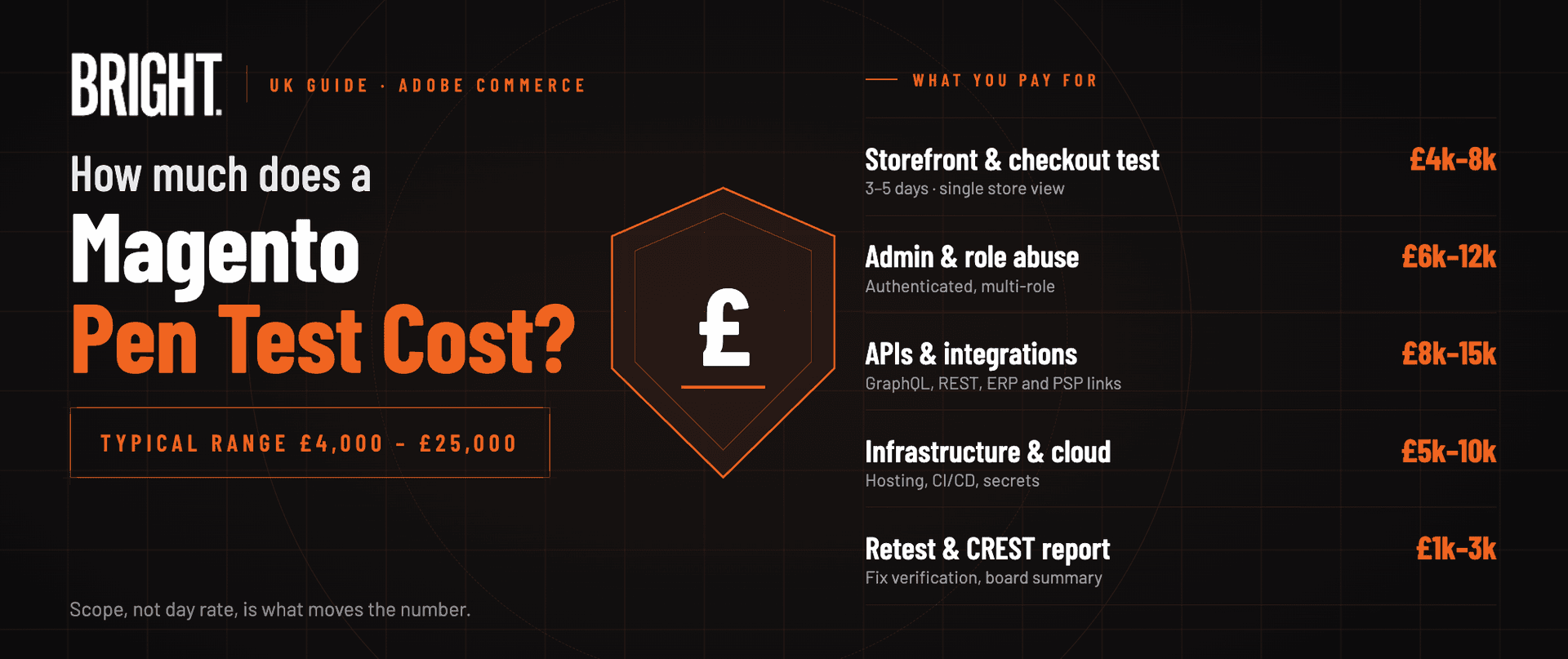
In short: A Magento penetration test cost in the UK typically ranges between £7,000 and £15,000 in 2026 for a standard store. Simpler sites cost around £4,000, and large or complex enterprise stores running £20,000 and up. Pricing is driven by scope and tester time. Most engagements are quoted at roughly £1,000-£1,500 per tester per day over five to eight days. Compliance-driven tests (PCI DSS) usually add 15-25%, and anything under about £4,000 is generally an automated scan rather than a true penetration test.
How much does a Magento penetration test cost in the UK?
Most Magento stores should budget £7,000-£15,000 for a proper, manual web-application penetration test in 2026. A Magento or Adobe Commerce store almost always includes user authentication, payment processing, role-based admin access and several third-party integrations, which puts it at ‘medium complexity’ or above, not the cheapest tier. Here is how the market breaks down.
| Engagement type | Typical UK cost (2026) | Typical duration |
|---|---|---|
| Automated vulnerability scan (not a pen test) | Under ~£4,000, often a monthly subscription | Continuous |
| Small/simple store, web-app pen test | £4,000-£7,000 | 3-5 days |
| Typical Magento store (auth, payments, roles, integrations) | £7,000-£15,000 | 5-8 days |
| Large/complex/multi-environment enterprise store | £15,000-£25,000 | 10-20 days |
| PCI- or compliance-driven engagement | Add ~15-25% to the above | N/A |
Pen tests are usually priced on tester time. UK day rates for CREST-certified consultants generally run £1,000-£1,500 per tester per day, with a fair benchmark around £1,200. The total is calculated from multiplying that day rate by the number of days your scope requires. So the real question is never ‘what’s the price?’ but ‘how many days, and doing what?’ Expect two to four weeks from scoping to final report.
What drives the cost of Magento pen testing?
Scope is the single biggest factor, specifically how much there is to test and how deep the testing goes. Two quotes for a Magento pen test can differ fivefold and still both be fair. The main drivers are:
- The size and complexity of the store. This includes the number of user roles, custom modules, payment flows, APIs and integrations. A heavily customised B2B store takes far longer than a near-stock B2C one.
- Test type. Black-box (no prior access), grey-box or white-box (full access and source). More access usually means more thorough findings for the same timeframe.
- Compliance requirements. Where a test needs to support PCI DSS compliance, providers may have to follow stricter methodology, evidence capture and reporting, which adds cost. It’s worth knowing that PCI DSS doesn’t require the tester to be a Qualified Security Assessor (QSA) or an Approved Scanning Vendor (ASV), so don’t assume you’re paying for that.
- Retesting. Confirming your fixes actually worked. Quality providers include a retest window; cheaper ones bill it separately.
- Provider tier and accreditation. CREST-accredited and senior testers cost more, but the gap between a junior automated pass and senior manual testing is where real risk is found.
Why are some Magento penetration testing costs and quotes so different?
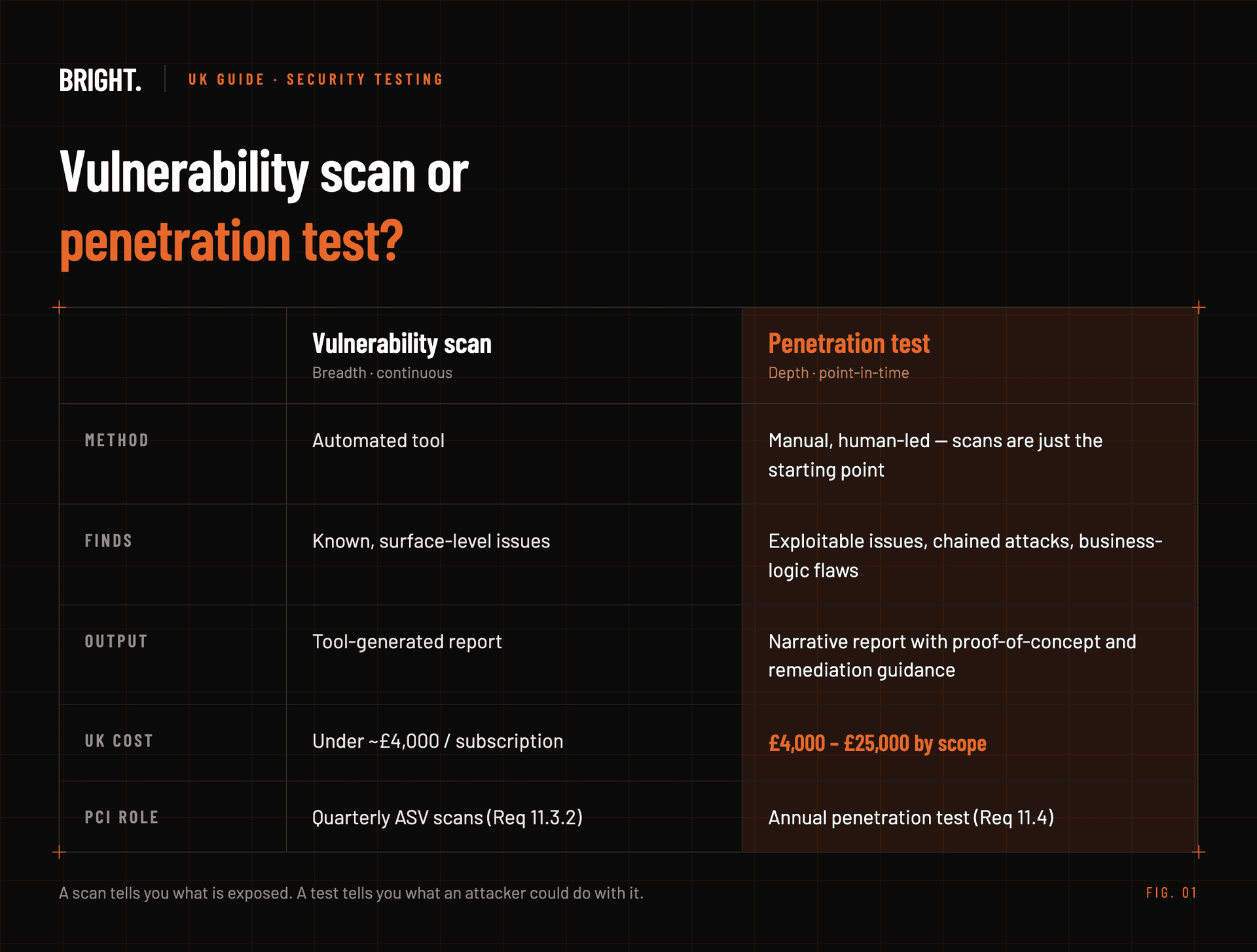
Because a low price almost always means automation instead of human testing. This is the most important thing to understand before you buy. A genuine Magento penetration test is manual: a qualified tester uses automated scans as a starting point, then tries to exploit findings, chain them together and reach data the way a real attacker would.
Anything priced under roughly £4,000, and most ‘always-on’ monthly subscriptions, is a vulnerability scan with a report. That has a place for routine hygiene, but it misses business-logic flaws, chained attacks and authentication bypasses, which are usually the highest-risk issues. The distinction matters enough to spell out. If you’re commissioning a test, the UK’s National Cyber Security Centre publishes free guidance on how to scope one and what ‘good’ looks like. CREST accreditation is a useful quality signal for the provider.
Magento penetration testing vs vulnerability scans: which is right for you?
Magento vulnerability scans and penetration tests are often used interchangeably, but they cover very different ground when it comes to protecting your store. A vulnerability scan is an automated process that checks your Magento site against a database of known issues, flagging surface-level weaknesses quickly and at a low cost. A penetration test goes much further: a human tester actively tries to exploit those weaknesses, chain them together, and uncover business-logic flaws that no automated tool would catch. The table below breaks down how the two compare on method, output, cost and where each fits into your PCI DSS obligations.
How often do you need to pen test a Magento store?
For any store taking card payments, the baseline is an annual penetration test plus quarterly scans, and another test after every major change. This isn’t just best practice; under PCI DSS v4.0 for Magento, it’s required. The PCI Security Standards Council mandates quarterly external scans by an ASV and quarterly internal scans (Requirement 11.3), plus internal and external penetration testing at least annually and after any significant change (Requirement 11.4).
UK and EU data-protection law works differently. GDPR requires ‘appropriate’ security and ‘regular’ testing of its effectiveness, but sets no fixed interval. The regulator judges adequacy after an incident, not based on a calendar. Applications now routinely ask about controls such as multi-factor authentication (MFA), patching and security testing, so your policy conditions may influence how often you test and what evidence you need to keep on file.
The practical rule: Test annually, scan quarterly and retest after any version upgrade, checkout change or new integration.
What you should get for your money
A real penetration test ends in a narrative report you can act on, not a raw scanner export. Before you accept a quote, confirm that the deliverable includes:
- Severity-rated findings (using a scheme such as CVSS)
- Proof-of-concept evidence showing how each issue was exploited
- Prioritised remediation guidance your developers can follow
- A retest to verify the fixes
For a Magento store, also check that the tester understands the specific platform, its admin model, extension ecosystem and payment architecture, rather than treating it as a generic web app. That platform fluency is what turns a long list of theoretical issues into the handful that actually put your store at risk.
A penetration test tells you where you stand. Acting on it – and keeping it current – is what protects your store and customers. If you’d like a scoped, fixed-price quote for your Magento or Adobe Commerce store, talk to our team about Magento penetration testing.
Why work with Bright for your Magento penetration test
Getting a genuine, standards-compliant penetration test matters as much as getting one at all. At Bright, we work with CREST-certified consultants to carry out your Magento penetration test to the recognised standard for UK security testing. So you get a proper manual assessment rather than an automated scan with a report attached.
Because we’re Magento and Adobe Commerce specialists first, our testing goes beyond generic web-app checks. We understand the platform’s admin model, extension ecosystem and payment architecture, so findings are prioritised by what actually puts your store and customers at risk, not just what a scanner flags. Whether you need a one-off test to satisfy PCI DSS Requirement 11.4 or an ongoing programme of annual testing and quarterly scans, our team can scope the right engagement for your store’s size and complexity.
Key takeaways
-
- A typical Magento penetration test costs £7,000-£15,000 in the UK in 2026; simpler stores start at around £4,000, and large or more complex stores run to £20,000 and above.
- Pricing is day-rate driven, roughly £1,000-£1,500 per tester per day, so the real variable is how many days are required for your scope.
- Very low quotes – especially below typical UK consultant day rates – often indicate a heavily automated vulnerability scan rather than a thorough manual penetration test.
- PCI DSS requires an annual penetration test, plus quarterly scans and testing after significant changes; insurers increasingly require evidence too.
- Judge a quote by the deliverable, severity-rated findings, proof of concept, remediation guidance and a retest, and by whether the tester actually knows Magento.
Frequently asked questions
How much does a Magento penetration test cost?
In the UK in 2026, a standard Magento penetration test typically costs £7,000-£15,000. Simpler stores can start at around £4,000, while large or heavily customised enterprise stores run to £20,000 or more. The price is set mainly by scope and the number of tester days required.
How long does a Magento penetration test take?
Most engagements involve five to eight days of tester time for a typical store, or longer for complex, multi-environment platforms. From initial scoping to the final report, expect two to four weeks.
How often should I run a Magento penetration test?
At least once a year, and again after any significant change, such as a version upgrade, checkout redesign, new integration or infrastructure migration. If you take card payments, PCI DSS requires this annual testing alongside quarterly vulnerability scans.
What’s the difference between a penetration test and a vulnerability scan?
A vulnerability scan is automated and finds known, surface-level issues. A penetration test is manual: a qualified tester actively exploits weaknesses, chains them together and demonstrates real attack paths. Scans are a hygiene measure; pen tests are an assurance exercise. PCI DSS requires both.
Does PCI DSS require a Magento store to have a penetration test?
Yes. PCI DSS Requirement 11.4 requires internal and external penetration testing at least annually and after significant changes, in addition to the quarterly ASV scans under Requirement 11.3. They’re separate obligations and one can’t replace the other.
Why are some Magento pen test quotes so much cheaper than others?
Usually because the cheaper option is largely automated. Real penetration testing is human-led and priced on senior tester time, so very low quotes typically reflect a vulnerability scan with a polished report rather than genuine manual testing and exploitation.
How much does a Magento penetration test cost?
In the UK in 2026, a standard Magento penetration test typically costs £7,000-£15,000. Simpler stores can start at around £4,000, while large or heavily customised enterprise stores run to £20,000 or more. The price is set mainly by scope and the number of tester days required.
How long does a Magento penetration test take?
Most engagements involve five to eight days of tester time for a typical store, or longer for complex, multi-environment platforms. From initial scoping to the final report, expect two to four weeks.
How often should I run a Magento penetration test?
At least once a year, and again after any significant change, such as a version upgrade, checkout redesign, new integration or infrastructure migration. If you take card payments, PCI DSS requires this annual testing alongside quarterly vulnerability scans.
What’s the difference between a penetration test and a vulnerability scan?
A vulnerability scan is automated and finds known, surface-level issues. A penetration test is manual: a qualified tester actively exploits weaknesses, chains them together and demonstrates real attack paths. Scans are a hygiene measure; pen tests are an assurance exercise. PCI DSS requires both.
Does PCI DSS require a Magento store to have a penetration test?
Yes. PCI DSS Requirement 11.4 requires internal and external penetration testing at least annually and after significant changes, in addition to the quarterly ASV scans under Requirement 11.3. They’re separate obligations and one can’t replace the other.
Why are some Magento pen test quotes so much cheaper than others?
Usually because the cheaper option is largely automated. Real penetration testing is human-led and priced on senior tester time, so very low quotes typically reflect a vulnerability scan with a polished report rather than genuine manual testing and exploitation.

WRITTEN BY
Marcin Szterling
Marcin Szterling is a lead Magento developer and Adobe-certified Master Architect with more than ten years of experience on Adobe Commerce and more than 30 years in web development. He specialises in complex multi-store, multi-currency builds and Commerce deployments, with 50+ Magento projects successfully delivered.