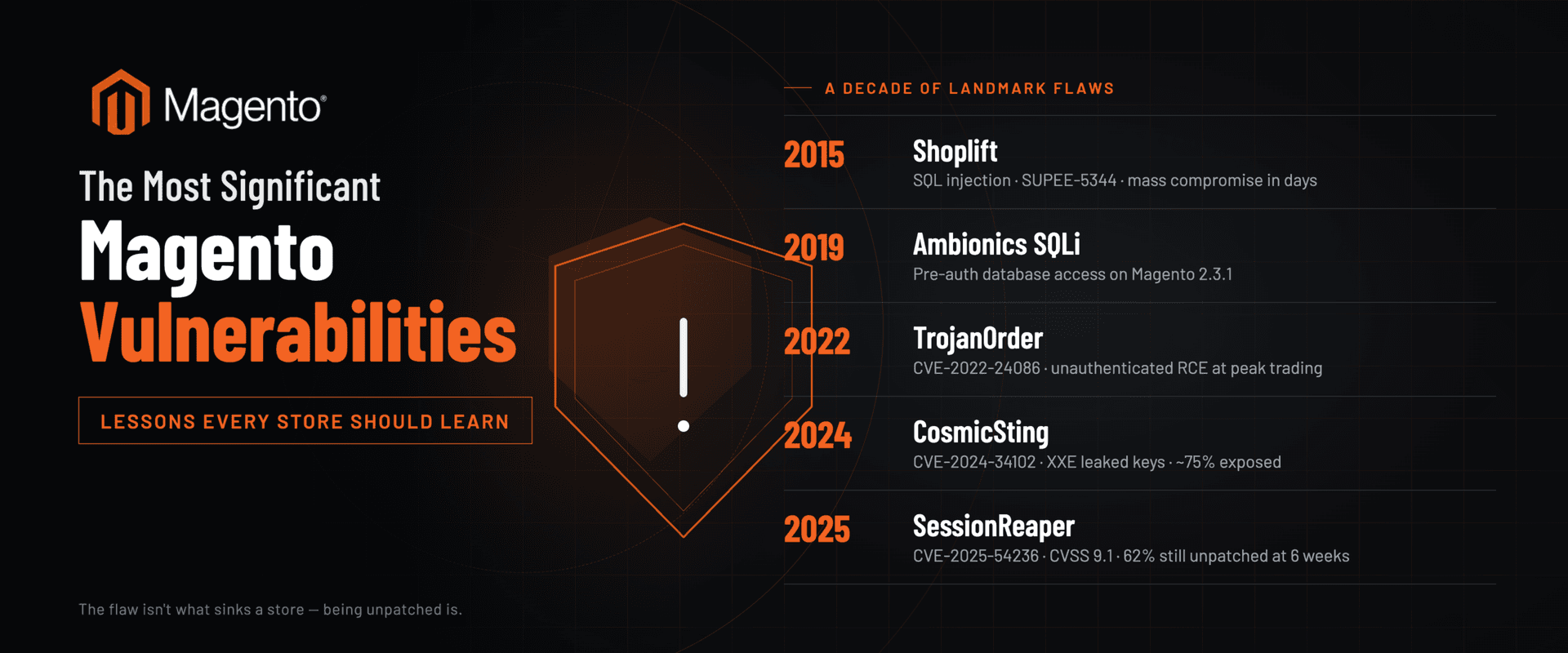
In short: Magento has seen several landmark vulnerabilities: Shoplift (2015), the Ambionics SQL injection (2019), TrojanOrder (2022), CosmicSting (2024) and SessionReaper (2025). Each was rapidly weaponised after disclosure and led to thousands of compromised stores. The common thread isn’t that the flaws were unstoppable, but that the stores they hit were unpatched. The lesson is consistent: patch fast, monitor for compromise and run layered defences.
The major Magento vulnerabilities at a glance
These vulnerabilities represent some of the most significant security events in Magento’s history. They also show how the threat landscape has evolved, from SQL injection and database compromise to sophisticated attack chains capable of taking over entire stores.
The examples below are worth knowing because they illustrate a recurring pattern. Vulnerabilities are often exploited quickly once details become public, and the impact can extend far beyond the original technical flaw. For Magento store owners, they underline why vulnerability monitoring, timely patching and regular security assessments are essential, rather than treating security as a one-off task.
Shoplift (2015)
Shoplift, fixed by the SUPEE-5344 patch, is the incident that put Magento security on the map. It was an SQL injection flaw that allowed attackers to take control of a store. A,fter the details became public, automated campaigns compromised a very large share of unpatched Magento stores within days. The lesson it taught – that disclosure starts a race, and unpatched stores lose it – has been re-taught with every major flaw since.
Ambionics SQL injection (2019)
Discovered by the security firm Ambionics, this SQL injection vulnerability affected Magento 2.3.1 and allowed pre-authentication access to the database, meaning an attacker needed no credentials to begin extracting data. Because it hit a widely deployed version, the exposure was broad. It reinforced that even the modern Magento 2 codebase isn’t immune, and that database-layer flaws are particularly dangerous due to the sensitive data they expose.
TrojanOrder (CVE-2022-24086, 2022)
TrojanOrder was an improper-input-validation flaw that enabled unauthenticated remote code execution. This is the most severe class of vulnerability, because it lets an attacker run their own code on your server without logging in. Adobe issued emergency patches, but mass-exploitation campaigns ramped up later in the year around the critical peak-trading period, when stores are most reluctant to touch production. That timing was the lesson in itself: attackers deliberately strike when you’re least willing to patch.
CosmicSting (CVE-2024-34102, 2024)
CosmicSting was an XML External Entity (XXE) injection flaw that, on its own, let unauthenticated attackers read sensitive server files, including the store’s encryption key. With that key, attackers could forge admin sessions, and when chained with a separate technique it enabled full remote code execution. Security researchers estimated it left around three-quarters of Adobe Commerce and Magento stores exposed, and it fuelled widespread card-skimming campaigns. The lesson: a single flaw that leaks a secret can unravel your entire security model, and ‘low-severity-looking’ information disclosure can be the first link in a catastrophic chain.
SessionReaper (CVE-2025-54236, 2025)
The most recent landmark flaw, SessionReaper was an improper-input-validation vulnerability in the Commerce REST API. It allowed unauthenticated customer-account takeover and, under certain conditions, remote code execution, rated a critical CVSS 9.1. Adobe broke its normal release schedule to ship an emergency patch. Despite that urgency, security firm Sansec found that, six weeks after the patch, roughly 62% of stores still hadn’t applied it, and mass-exploitation attempts began as soon as exploit details circulated. The lesson was painfully familiar: the patch existed; most stores simply hadn’t installed it in time.
The pattern, and what it teaches
Look across these Magento vulnerabilities and the same story repeats: the vulnerability isn’t what sinks most stores; being unpatched is. In almost every case, a fix was available, attackers reverse-engineered it within hours or days, and the stores that got hit were the ones that hadn’t applied it yet. You can take three lessons from this:
There’s also a current bright spot worth noting. Since early 2026, Adobe has moved to monthly security patches for supported branches, making a disciplined patch cadence more achievable than ever, if you have the process to keep up.
Patch speed is everything
Disclosure starts a countdown measured in hours, not weeks. A documented patching SLA for critical fixes is the single highest-value control possible
Assume you can’t always patch instantly, so add layers
A web application firewall can often block an exploit pattern at the edge before you’ve applied the official fix, and monitoring will catch a compromise that slips through. This is the case for layered security
Detection matters as much as prevention
Several of these campaigns ran quietly for weeks. File-integrity and payment-page monitoring are what turn months of undetected access into an immediate alert
How to stay ahead of new Magento vulnerabilities
Every lesson above comes back to the same thing: the stores that come through unscathed are the ones that hear about a flaw early and act on it. So knowing where to watch for new Magento vulnerabilities is half the job. It’s worth wiring up a few reliable sources and checking them as part of your routine.
- Official Adobe channels. Adobe publishes every Magento Open Source and Adobe Commerce disclosure as a security bulletin under its APSB naming convention, and you can subscribe to be alerted the moment a new one lands.
- Ecommerce threat intelligence. A lot of real-world breaches start in unpatched third-party modules rather than core code, so independent specialists often spot emerging threats first. Sansec is the best-known ecommerce malware and threat-hunting firm and tracks active exploitation in the wild, while MageReport offers a free, quick-look scan of a live store’s exposure.
- Vulnerability databases. For flaws in Magento’s wider dependencies, the MITRE CVE List and the National Vulnerability Database (NVD) let you track entries by keyword, such as ‘Magento’, ‘Adobe Commerce’ or ‘Magento Open Source’.
- Community channels. The r/Magento subreddit and Magento Stack Exchange are useful for early warnings and practitioner chatter when something’s being actively exploited, though you should confirm anything you see there against an official source before acting on it.
Build these into a simple habit – a weekly check, plus alerts on the official bulletins – and you turn ‘we didn’t know’ into ‘we knew within a day’, which is exactly the gap these incidents keep exploiting.
How to protect your store
Knowing the history is useful, but acting on it is what counts. The practical response is the same regardless of which flaw comes next. Run a Magento vulnerability assessment to find where you’re exposed, keep a strict patching cadence, layer a WAF and monitoring over the top, and, if you’re on the end-of-life Magento 1 platform, which receives no patches at all, treat migration as urgent. If you suspect you’ve already been caught by one of these, our guide on the signs your store has been hacked covers what to do.
Key takeaways
- Magento’s landmark vulnerabilities (Shoplift, Ambionics SQLi, TrojanOrder, CosmicSting, SessionReaper) each compromised thousands of stores after disclosure.
- The common factor in who got hit was almost always being unpatched, not the flaw being unstoppable.
- Attackers weaponise disclosed vulnerabilities within hours or days, deliberately targeting slow-to-patch stores (often at peak trading times).
- A fast-patching SLA, a WAF for virtual patching and monitoring for detection are the defences these incidents repeatedly validate.
- Magento 1 stores are permanently exposed to all of these, because they receive no patches at all.
If you’re not certain where your store stands against known vulnerabilities, a free Magento security scan checks your patch level and exposure, and a full security audit gives you the complete picture.
Frequently asked questions
What is the most serious Magento vulnerability?
Several rank among the most serious, all rated critical. TrojanOrder (CVE-2022-24086), CosmicSting (CVE-2024-34102) and SessionReaper (CVE-2025-54236) each allowed unauthenticated remote code execution or full store compromise, while Shoplift (2015) caused the first mass wave of Magento compromises. The severity is similar; what made each devastating was how quickly unpatched stores were exploited.
Are Magento 2 stores still vulnerable?
Yes, being on Magento 2 or Adobe Commerce doesn’t make you immune. TrojanOrder, CosmicSting and SessionReaper all affected modern Magento 2 and Adobe Commerce versions. The protection isn’t the version number; it’s keeping that version patched and monitored.
How quickly are Magento vulnerabilities exploited after disclosure?
Very quickly, typically ranging from within hours to a few days. Attackers reverse-engineer the official patch to understand the flaw, then run automated scans for stores that haven’t applied it. This is why a fast-patching SLA matters so much.
How do I protect my store against these vulnerabilities?
Apply Adobe security patches promptly (ideally to a documented SLA), run a WAF that can block exploit patterns before you patch, monitor for file and payment-page changes, and assess your store regularly. If you’re on end-of-life Magento 1, migrating is the only real protection since it no longer receives patches.
Is my Magento store affected by CosmicSting or SessionReaper?
If you haven’t applied the relevant Adobe patches (or you’re on an unsupported version), assume you could be. The fastest way to check is a security scan that verifies your patch level and looks for signs of compromise.

WRITTEN BY
Marcin Szterling
Marcin Szterling is a lead Magento developer and Adobe-certified Master Architect with more than ten years of experience on Adobe Commerce and more than 30 years in web development. He specialises in complex multi-store, multi-currency builds and Commerce deployments, with 50+ Magento projects successfully delivered.